
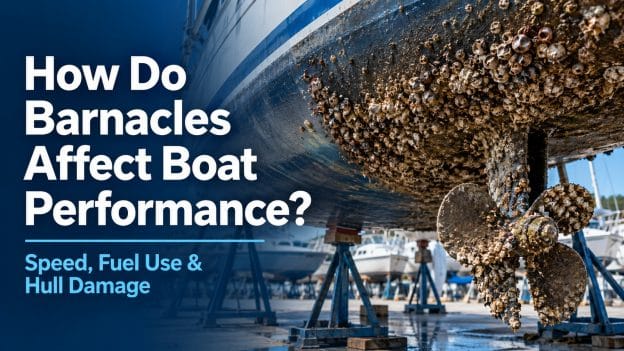
Barnacles may look like a minor maintenance problem, but they can have a major effect on how a boat performs.
Quick Answer
Barnacles can reduce boat speed, increase drag and fuel consumption, affect handling, and damage underwater surfaces if they are allowed to build up.
Even relatively small amounts of marine growth can disturb the smooth flow of water across the hull.
As barnacles accumulate, the boat has to work harder to move through the water. That can mean slower speeds, higher fuel use, and more strain on the engine and drivetrain.
Antifouling bottom paint is one of the primary ways boat owners help prevent barnacles and other marine organisms from attaching to submerged surfaces.
What Happens When Barnacles Grow on a Boat?
Barnacles attach themselves to submerged surfaces and form hard shells that create a rough, uneven surface.
On a clean hull, water flows relatively smoothly along the bottom of the boat.
Once barnacles, slime, algae, and other marine growth begin accumulating, that smooth flow is disrupted.
The result is increased hydrodynamic drag.
That additional resistance can affect:
- Boat speed
- Fuel economy
- Acceleration
- Handling
- Engine workload
- Propeller efficiency
The heavier the growth becomes, the greater the potential impact on performance.
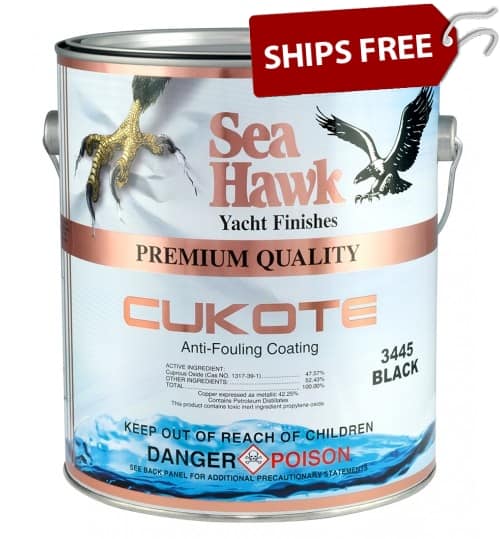
Sea Hawk Cukote bottom paint is an ablative, self-polishing antifouling paint that uses an enhanced, copolymer, biocide release mechanism.
Do Barnacles Slow a Boat Down?
Yes.
Barnacles create drag by making the underwater surface of the boat rougher.
A smooth hull moves through the water efficiently. A hull covered with barnacles and marine growth creates turbulence and additional resistance.
As a result, a boat may:
- Take longer to get on plane
- Lose top-end speed
- Accelerate more slowly
- Require more throttle to maintain cruising speed
The performance loss becomes more noticeable as fouling increases.
Do Barnacles Increase Fuel Consumption?
They can.
When marine growth increases hull resistance, the engine must produce more power to maintain the same speed.
That means the boat may burn more fuel for the same trip.
A boat owner may notice that:
- Normal cruising speed requires more throttle
- Fuel consumption increases
- Engine RPM may be higher than usual for a given speed
- Range between fuel stops decreases
If fuel economy suddenly worsens and there are no obvious mechanical problems, hull and running-gear fouling should be considered.
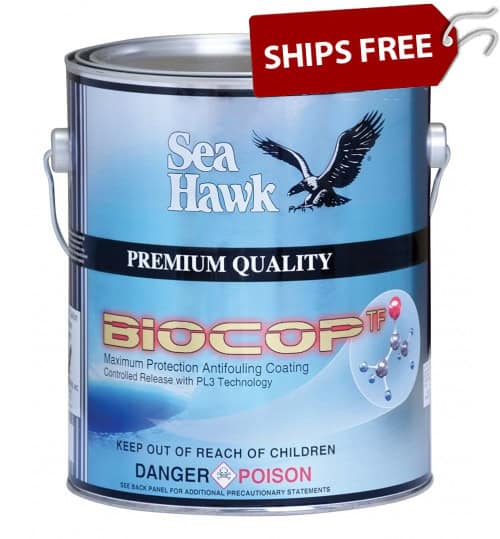
Biocop TF was developed as an alternative to tin-based antifouling paints to protect against the harshest marine environments.
Can Barnacles Affect Boat Handling?
Yes.
Heavy or uneven marine growth can affect the way a boat moves through the water.
Barnacles may contribute to:
- Reduced responsiveness
- Slower acceleration
- Difficulty reaching normal cruising speed
- Increased vibration
- Changes in steering feel
Growth on rudders, trim tabs, struts, and other underwater components can also reduce their effectiveness.
Can Barnacles Damage a Boat Hull?
Barnacles generally cause more performance problems than structural damage, but they can still create maintenance issues.
Their shells attach strongly to surfaces.
Removing heavily attached barnacles can sometimes damage:
- Bottom paint
- Gelcoat
- Protective coatings
- Primers
- Painted metal surfaces
Aggressive scraping can make the problem worse by damaging the surface underneath.
If barnacles are repeatedly allowed to build up, removing them can become more difficult and more expensive.
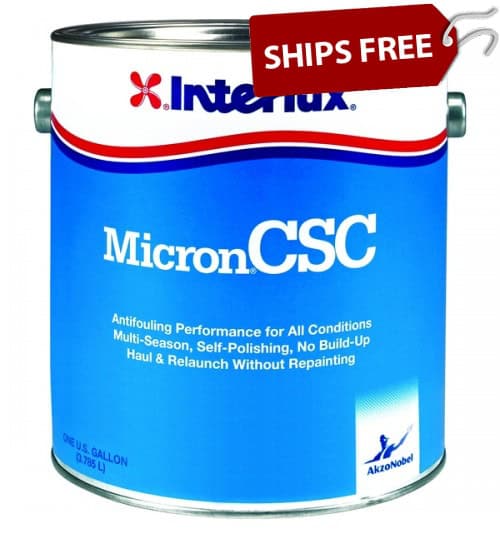
Interlux Micron CSC is a popular multi-season ablative paint that provides ongoing antifouling protection while gradually wearing away during use.
Can Barnacles Damage Propellers and Running Gear?
Barnacles can be particularly troublesome on underwater hardware.
They can grow on:
- Propellers
- Shafts
- Struts
- Rudders
- Trim tabs
- Outdrives
- Lower units
Growth on a propeller can interfere with smooth water flow across the blades.
This may lead to:
- Reduced propeller efficiency
- Slower acceleration
- Vibration
- Higher engine load
- Reduced top speed
Even if the hull is relatively clean, heavily fouled running gear can significantly affect performance.
How Quickly Can Barnacles Grow on a Boat?
Barnacle growth varies widely depending on environmental conditions.
Fouling tends to be heavier in areas with:
- Warm water
- High nutrient levels
- Strong marine growth
- Long periods of boat inactivity
- Saltwater or brackish water
- Limited water movement in marinas or canals
Some boats can begin developing noticeable marine growth surprisingly quickly when conditions are favorable.
This is why local boating conditions are important when selecting an antifouling paint.
Why Do Some Boats Get More Barnacles Than Others?
Two boats kept in the same general area can experience very different levels of fouling.
Factors include:
Water Temperature
Warmer water often supports faster marine growth.
Water Salinity
Saltwater and brackish water support many fouling organisms, including barnacles.
Boat Usage
A boat that sits unused for long periods may experience more growth than a boat that moves frequently.
Marina Conditions
Water circulation, sunlight, nutrients, and nearby structures can all influence fouling.
Type of Bottom Paint
Antifouling paints use different technologies and active ingredients.
A paint that performs well in moderate-fouling freshwater may not provide enough protection in a high-fouling coastal environment.
Do Barnacles Grow on Boats That Are Used Frequently?
Yes, although regular use can sometimes help reduce certain types of growth.
Boat movement creates water flow across the hull.
With some ablative bottom paints, this movement also helps wear away the outer surface of the coating and expose fresh antifouling material.
However, regular use does not guarantee that barnacles will not form.
If the antifouling coating is worn out or not appropriate for local conditions, marine growth can still develop.
How Do You Remove Barnacles From a Boat?
Barnacles should be removed carefully to avoid damaging the hull or protective coating.
Depending on the severity of the growth, removal may involve:
- Hauling the boat out of the water.
- Pressure washing the hull while growth is still wet.
- Carefully scraping remaining barnacles.
- Inspecting the bottom paint and underlying surface.
- Repairing damaged or worn areas before relaunching.
Heavy scraping can damage bottom paint or gelcoat, so avoid using excessive force.
If the coating underneath the barnacles is failing, additional preparation may be required before repainting.
Should You Remove Barnacles While the Boat Is in the Water?
Some boat owners have hulls cleaned by professional divers.
Whether underwater cleaning is appropriate depends on:
- The type of bottom paint
- Local environmental regulations
- The severity of the growth
- The condition of the coating
Aggressive underwater cleaning can remove or damage some antifouling paints.
Always follow the bottom-paint manufacturer’s cleaning recommendations.
How Do You Prevent Barnacles From Growing on a Boat?
The most common method is applying antifouling bottom paint to surfaces that remain underwater.
Antifouling coatings are designed to discourage marine organisms from attaching to the hull.
To improve protection:
- Select a bottom paint appropriate for local fouling conditions.
- Apply the recommended number of coats.
- Follow surface-preparation instructions carefully.
- Apply extra paint to high-wear areas when recommended.
- Observe proper launch and recoat windows.
- Inspect the hull regularly.
- Repaint when the antifouling coating begins losing effectiveness.
Proper application is just as important as choosing the right paint.
What Is the Best Bottom Paint for Preventing Barnacles?
There is no single best antifouling paint for every boat.
The correct choice depends on:
- Freshwater vs. saltwater
- Local fouling pressure
- Boat speed
- How often the boat is used
- Hull material
- Seasonal vs. year-round use
- Whether the boat is stored in or out of the water
Ablative Bottom Paint
Ablative paints gradually wear away during use, exposing fresh antifouling material.
They are popular with many recreational boat owners because they can reduce paint buildup over time.
Hard Bottom Paint
Hard antifouling paints form a durable coating and are commonly used on faster boats or boats that are used frequently.
Multi-Season Bottom Paint
Some antifouling coatings are designed to provide protection across multiple boating seasons when properly applied and maintained.
Aluminum-Safe Bottom Paint
Aluminum boats require antifouling coatings specifically approved for aluminum.
Traditional copper-based bottom paints should not be applied directly to aluminum unless the product is specifically designed and approved for that use.
How Do You Know If Your Bottom Paint Is No Longer Preventing Barnacles?
Increasing fouling is one of the clearest signs that your antifouling protection may be weakening.
Other warning signs include:
- Barnacles appearing sooner than before
- Heavy slime or algae buildup
- Thin or worn areas of paint
- Exposed primer or substrate
- Peeling or flaking paint
- Worn areas along leading edges and waterlines
If the hull begins fouling much faster than it did previously, it may be time to inspect or repaint the bottom.
Can Bottom Paint Completely Eliminate Barnacles?
No antifouling coating can guarantee that a boat will remain completely free of marine growth under every condition.
Bottom paint is designed to reduce and control fouling.
Performance depends on:
- Correct product selection
- Proper application
- Coating thickness
- Water conditions
- Boat usage
- Age of the coating
Periodic inspection and maintenance are still necessary.
Barnacles vs. Slime and Algae: What Is the Difference?
Marine fouling includes several types of organisms.
Slime
Slime is usually soft biological growth that develops on submerged surfaces.
Algae
Algae can form green, brown, or darker growth on the hull.
Barnacles
Barnacles are hard-shelled organisms that firmly attach themselves to submerged surfaces.
Barnacles are particularly troublesome because they create substantial surface roughness and can be difficult to remove.
A good antifouling strategy should address the types of fouling common in the waters where the boat is kept.
Frequently Asked Questions
Can a few barnacles really affect boat performance?
Yes. Even relatively light fouling increases surface roughness and drag. The effect becomes progressively greater as barnacle growth increases.
Why is my boat slower even though the engine seems fine?
A fouled hull or propeller can reduce boat speed even when the engine is operating normally. Inspect underwater surfaces for barnacles, slime, and other marine growth.
Will barnacles fall off when the boat goes faster?
Do not rely on boat speed to remove barnacles. Once established, barnacles can attach very firmly to underwater surfaces.
Does freshwater have barnacles?
Traditional marine barnacles are primarily associated with saltwater and brackish environments, but freshwater boats can still experience substantial fouling from algae, slime, mussels, and other organisms.
Does bottom paint kill barnacles?
Antifouling paint is intended to prevent or discourage marine organisms from successfully attaching and growing on submerged surfaces. Its effectiveness depends on the paint technology, condition of the coating, and local fouling environment.
How often should you repaint bottom paint to prevent barnacles?
There is no single schedule for every boat. Many boat owners inspect or repaint every season or every one to two years, depending on the antifouling product, water conditions, and coating performance.
Bottom Line
Barnacles affect boat performance primarily by increasing underwater drag.
As marine growth builds up, a boat may:
- Lose speed
- Burn more fuel
- Accelerate more slowly
- Handle less efficiently
- Experience propeller or running-gear problems
Preventing fouling is usually easier and less expensive than removing heavy barnacle growth later.
A properly selected and correctly applied antifouling bottom paint can help reduce barnacle attachment and keep your boat performing more efficiently.
Bottom Paint Store offers a wide range of ablative, hard, multi-season, and aluminum-safe antifouling paints for different boats, hull materials, and fouling conditions. If you need any assistance selecting the right product for your needs, please contact us 888-505-2313 M-F 9-5 EST.