Best Performing Bottom Paint
The best bottom paint for boats that money can buy may NOT be the most expensive. You should buy the bottom paint that works best in your area. That will depend on the temperature of the water, tide changes, the nutrients in the water that feed unwanted growth, and many other factors.
There is no single bottom paint that is best for every boat.
The best antifouling paint depends on your hull material, fresh or saltwater use, local fouling pressure, water temperature, how often the boat is used, and whether you prefer a hard or self-polishing coating.
For boats operating in warm water or areas with heavy barnacle and marine growth, a premium antifouling paint such as Sea Hawk Biocop TF or Pettit Trinidad XSR may be appropriate. Boats operating in lighter fouling conditions may not need the additional expense of the most aggressive antifouling system.
The goal is to select the right level of protection for your actual boating conditions, rather than simply choosing the most expensive paint.
Best Bottom Paint by Boating Situation
| Boating situation |
Paint type or product to consider |
| Heavy fouling / severe barnacle growth |
High-performance antifouling such as Sea Hawk Biocop TF or Pettit Trinidad XSR |
| Warm saltwater |
Premium multi-season antifouling designed for high-fouling environments |
| Boat kept in the water year-round |
Durable hard or premium self-polishing antifouling |
| Frequently used recreational boat |
Ablative or self-polishing antifouling |
| Aluminum hull |
Paint specifically approved for aluminum, typically copper-free or metal-free |
| Freshwater boat |
Antifouling selected for the local freshwater fouling level |
| Long periods between haul-outs |
Multi-season antifouling suited to local conditions |
| Smooth racing-type finish |
Hard-finish antifouling where appropriate |
Important: Always verify that a bottom paint is compatible with your hull material, existing coating and manufacturer-recommended primer system before applying it.
The best bottom paint for you will be the bottom paint that stops the growth and does not break your wallet. If you buy the best performing bottom for the harshest fouling conditions and the warmest waters you would need Sea Hawk Paints Biocop TF or another Top Performing Bottom Paint. This provides you the absolute maximum protection against hard and soft growth on the bottom of your boat. This solution is recommended for high growth areas, or if you are trying to goes as long as you possibly can between bottom jobs. If you are in cooler climates or lower fouling conditions you would NOT need to spend the extra money on Sea Hawk Biocop TF. A better choice that is less expensive and will work in these conditions is Sea Hawk AF-33 or the equivalent.
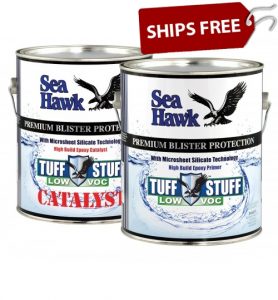
ALUMINUM BOATS: The best bottom paint for an aluminum boat or pontoons is a copper free bottom paint. You cannot put the paints mentioned above (Copper-Based) on aluminum because they contain copper and will react like a battery causing pitting (holes) on aluminum. Therefore, we recommend an Aluminum Safe Bottom Paint. A good choice for aluminum is Sea Hawk Colorkote, it is copper free triple biocide paint safe for aluminum. If the aluminum has never been painted the best practice is to prime with high build epoxy primer like Sea Hawk Tuff Stuff to insure good adhesion and protect against corrosion. If you are painting a pontoon boat for the first time – try our Pontoon Bottom Paint Kit.
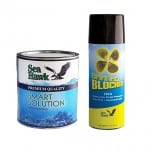 The best bottom paint for the outdrives is to brush on Smart Solution. (pint size). If your outdrive has never been painted before, you can use Barnacle Blocker Primer for priming the area application of bottom paint. A great value for this is the Premium Outdrive Bottom Paint Kit. If there is already a bottom paint on your running gear, just scuff sand and paint! Another option is to try an aerosol spray bottom paint. These are easy to apply.
For outdrives a foul release agent may be the choice for you, see here.
What Is the Best Bottom Paint for Heavy Fouling?
Boats kept in warm saltwater or areas with significant barnacle, shell and slime growth generally require stronger antifouling protection than boats used in cooler or lower-growth waters.
For severe fouling conditions, products such as Sea Hawk Biocop TF and Pettit Trinidad XSR are designed for demanding marine environments.
The best choice will also depend on whether you prefer a hard antifouling coating or a self-polishing paint.
A boat that remains in the water throughout the season may have different requirements than one that is trailered or frequently hauled.
Bottom Paint Store Recommendation
For high-growth areas, concentrate first on fouling protection, water conditions and coating type, then compare price. Using a less expensive paint that cannot handle your local growth conditions can result in additional cleaning or an earlier repaint.
What Bottom Paint Lasts the Longest?
How long bottom paint lasts depends on much more than the brand.
Important factors include:
- Type of antifouling paint
- Number and thickness of coats
- Surface preparation
- Freshwater versus saltwater
- Water temperature
- Fouling pressure
- How frequently the boat is used
- How long the boat remains in the water
Premium multi-season antifouling paints can provide extended protection when properly applied and used in appropriate conditions, but no bottom paint should be selected based on expected lifespan alone.
For more information, see our guide:
How Long Does Bottom Paint Last?
What Is the Best Bottom Paint for Saltwater?
Saltwater boats generally experience greater fouling pressure than many freshwater boats, particularly in warm, nutrient-rich areas.
Barnacles, shell growth, algae and slime can all affect the hull.
For boats kept in saltwater for extended periods, look for an antifouling paint specifically designed for the fouling conditions in your region.
High-fouling areas may justify a premium product such as Biocop TF or Trinidad XSR, while moderate-fouling locations may allow the use of a less aggressive—and less expensive—paint.
What Is the Best Hard Antifouling Bottom Paint?
Hard antifouling paints produce a durable coating and can be a good choice for boats that are used frequently, faster boats and applications where a harder, smoother surface is desirable.
One product to consider for demanding fouling conditions is Pettit Trinidad XSR, subject to compatibility with your boat and existing coating system.
Hard paints generally remain on the hull rather than gradually wearing away, so repeated applications can eventually create paint buildup that may require additional surface preparation.
What Is the Best Self-Polishing Bottom Paint?
Self-polishing antifouling paints are designed so the coating surface gradually renews as the boat moves through the water.
This helps expose fresh antifouling ingredients and can reduce excessive coating buildup compared with traditional hard paints.
Sea Hawk Biocop TF is one high-performance self-polishing option intended for demanding marine environments.
Self-polishing paints can be particularly attractive for boats that remain in the water for long periods and owners who want multi-season performance where the manufacturer and local conditions support it.
Hard vs. Ablative vs. Self-Polishing Bottom Paint
| Paint type |
Often best suited for |
Main advantage |
Main consideration |
| Hard antifouling |
Frequently used boats, faster boats, some racing applications |
Durable, smooth coating |
Paint film can build up over repeated applications |
| Ablative |
General recreational boating |
Surface gradually wears away |
Wear rate depends partly on boat use |
| Self-polishing |
Extended-use and multi-season applications |
Controlled surface renewal |
Usually a more premium coating system |
There is no universally superior type. The correct choice depends on how and where the boat is used.
Best Bottom Paint for Severe Barnacle Growth
Barnacle pressure tends to be greatest in warm, nutrient-rich water, particularly when a boat remains stationary for extended periods.
For these conditions, choose a bottom paint designed for high-growth marine environments rather than selecting primarily by price.
Two products worth comparing are:
Sea Hawk Biocop TF — a high-performance self-polishing antifouling paint.
Pettit Trinidad XSR — a high-performance hard antifouling paint.
Because these coatings use different technologies, the better choice depends on the boat, location and desired coating type.
What Bottom Paint Is Safe for Aluminum Boats?
Aluminum boats require special consideration.
Do not assume that a conventional copper-based antifouling paint is appropriate for an aluminum hull. Choose a product specifically approved by the manufacturer for use on aluminum and follow the recommended primer and application system.
Copper-free or metal-free antifouling products can be appropriate choices depending on the specific product and application.
For additional guidance, see our Aluminum-Safe Bottom Paint resources.
Copper-Free and Metal-Free Bottom Paint
Some boat owners prefer or require antifouling systems that do not rely on traditional copper-based technology.
Metal-free and copper-free paints can be useful for certain hull materials and applications, but their performance characteristics vary considerably by product.
Sea Hawk Smart Solution Metal Free Bottom Paint is one product to consider where its manufacturer-approved applications match your boat and operating conditions.
Which Bottom Paint Should I Buy?
Before choosing a bottom paint, answer these six questions:
- Is the hull fiberglass, aluminum, wood or another material?
- Will the boat operate primarily in fresh or saltwater?
- Is fouling in the area light, moderate or severe?
- Will the boat remain in the water year-round?
- How frequently is the boat used?
- What type of bottom paint is already on the hull?
Once those questions are answered, it becomes much easier to narrow the selection.
Bottom Paint Store Recommendation
The best bottom paint is not necessarily the most expensive product. It is the paint that provides the appropriate antifouling protection for your boat, water conditions and usage pattern without paying for performance you do not need.
For boats in severe fouling conditions, consider premium products such as Sea Hawk Biocop TF and Pettit Trinidad XSR.
For aluminum or applications requiring an alternative to conventional copper antifouling, consider a manufacturer-approved copper-free or metal-free system such as Sea Hawk Smart Solution where appropriate.
Related Guides
- Pettit Trinidad XSR Triple Biocide Bottom Paint
- Sea Hawk Biocop TF Self-Polishing Bottom Paint
- Sea Hawk Smart Solution Metal Free Bottom Paint
- Micron 66 vs. Biocop TF
- How Long Does Bottom Paint Last?
- How Do Barnacles Affect Boat Performance?
- Aluminum-Safe Bottom Paint
Last Updated: October 2026
Reviewed by Bottom Paint Store
Bottom Paint Store specializes in antifouling paints, marine coatings, gelcoat and boat-maintenance products, with product information and application resources designed to help boat owners select the appropriate coating system for their boating conditions.